
Author Credits:
From the Editor
It’s been over 1000 days since October 7th.
Leaving aside the semantics of genocide, that’s 1000 days of disingenuous headlines about “ceasefire”; 1000 days of cosplay promises to American Presidents; 1000 days when the dismemberment of Gaza abated, effectively, not one whit.
What pauses in slaughter that have occurred, served mostly to afford drone operators a bathroom break and Israeli snipers time to reload. The cat and mouse pretenses of allowing in a few more aid trucks were never seriously confronted by the United States, or the ‘international community’; instead, Biden/Blinken let a $320 million pier to nowhere drift out to sea while the Gaza Humanitarian Foundation lined the pockets of Christian nationalists and established concierge new killing fields for the IDF. Beachfront real estate was dangled before an easily distracted POTUS, and at no point– despite Kushner/Witkoff ’s always mild protestations– did Israel concede on its maximalist aim: the systematic and unfailingly cruel eradication of the indigenous population.
Whether under the overtly bogus pretense of targeting terror or the more aimless assertion of ‘sovereignty’, Israel continues to kill people who can neither hide, nor flee, nor defend themselves. As We Are Not Numbers’ name suggests, bodycounts can have a numbing and obfuscating effect. In Gaza, where 75,000 Palestinians are known to have been killed, other estimates go much, much, much higher, with damage and disruption that is utterly incalculable. Over one thousand more lives were taken in the West Bank by IDF and settler violence, and several times that number were exterminated in Lebanon, with entire villages razed by Israeli detonations and demolitions. The United States was then conscripted in Israel’s aggression against Iran, and now finds itself mired deep in a conflict it is increasingly unable to explain, let alone extricate itself from.
American citizens who managed to maintain a grasp of reality understood that genocide’s appetite for women and children caught in the rubble was not only criminally wrong, but also posed a threat to their own lives, liberty and pursuits of happiness. The question those Americans may now be asking is, What’s left when our integrity’s all gone?
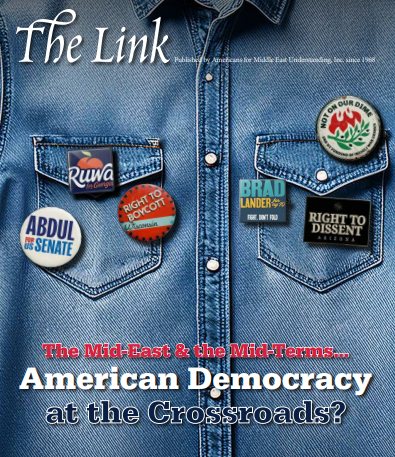
Readers of The Link understand that the gauntlet has been thrown down, and that endless war and American principle cannot longer co-exist. Our eyes are on November, when American voters— and particularly Generations X, Y and Z— have no choice but to break the two-party stranglehold. With that in mind, we’re pleased to host a range of views about how a live-streamed genocide in Gaza affects voters looking for answers in November:
Congresswoman Marie Newman explores how Illinoisans broke the mold in 2026
Professor Alan Wald on Academic Freedoms and elections in Michigan
Filmmaker Daniel Nerenberg looks at attempts to Repeal Anti-Boycott legislation
Journalist Ian Williams parses party politics in New York
America’s health may not be as bad as say, Donald Trump’s, but it’s far from hale and hearty. The sclerosis in all three branches of our body politic presents risks we can no longer afford to ignore, and voters in 2026 seem to be grasping how endless war abroad jeopardizes democracy at home.
-Nicholas Griffin
PS: The “Question Authority” button will be familiar to people of a certain age. For others, a quick internet search may be informative.
How the Palestine-Israel Divide Reshaped Illinois Democratic Primaries
By Marie Newman
When Peace Politics Became the Focus
On March 17, Chicagoans headed to the polls on what would otherwise be a typical, windy spring day in Illinois: primary election day. Clutching their umbrellas in one hand and sample ballots in the other, many Chicago voters had spent weeks researching an issue that rarely shapes Democratic primaries: where candidates stood on a crisis 6,000 miles away. Other voters, who likely made up a plurality of constituents in the area, arrived with less certainty with their choices and were “winging it.”
Maria, a 34-year-old teacher from Pilsen visited her voting place midday to avoid the busiest hours. Although she had rarely paid much attention to foreign policy in local races in the past, this election cycle was different: “I have students whose families are from Gaza,” she told me outside polling location. “When I see what’s happening to children there, I can’t just vote based on who’ll fix the potholes anymore.”
Maria was not alone.
A Seismic Shift in Democratic Politics
The March 17 Democratic primaries across Illinois—particularly in Cook County—became an unexpected referendum on American policy toward Israel and Palestine. What emerged was about more than any individual race. It revealed a deeper shift: a fundamental realignment within the Democratic coalition that establishment figures either did not see coming or hoped would fade away. For the record, it has not faded and it will not.
Voter turnout across the city of Chicago reached 27 percent, exceeding participation levels in Illinois’ two previous midterm primary cycles. In DuPage County, voter turnout reached a predictable 25.4 percent, which is consistent with previous years, while turnout in Will County was lower, at 19.9 percent.
Turnout rates across Chicago tell part of the story on the centrality of Palestine in today’s elections. In Illinois’ 6th Congressional District, where the highest concentration of Palestinian Americans reside in any U.S. congressional district, solidarity with Palestine has become a central issue. In this race, turnout among voters under 40 was 23 percent higher than it was in the 2022 primary. Palestine was also top of mind in Chicago’s 9th, which encompasses parts of Chicago’s North Shore and Evanston. It is also the district with the highest concentration of Jewish Americans in Illinois. The subject of Palestine solidarity even became a campaign issue for three school board candidates who explicitly called to divest from companies doing business in Israeli settlements. Those candidates won decisively. Even so, voter turnout figures alone cannot capture the intensity with which Israel-Palestine shaped this election cycle.
More illustratively, in all the Chicago area congressional races (IL-01, 02, 03, 04, 05, 06, 07, 08, 09, 10), the topic of Palestine and Israel surfaced at nearly every forum, interview, and debate. For the first time in many congressional race polls in Illinois, Palestine was ranked among the top five issues for primary voters.
The AIPAC Factor: Money Talks, Voters Walk
The American Israel Public Affairs Committee (AIPAC) poured unprecedented resources into Illinois races this cycle. Through its super PAC, United Democracy Project, AIPAC spent approximately $22 million in Illinois primaries—a staggering sum for state and local races. AIPAC’s strategy was clear and aggressive: to support candidates aligned with Israel while relentlessly attacking those who were not. AIPAC’s go-to model relies heavily on character assassinations of candidates and damaging candidates’ reputations.
However, AIPAC is still conscious of how toxic their brand is. The organization has rebranded itself into a network of shell PACs with the following more palatable names: United Democracy Project, Elect Chicago Women, Chicago Progressive Project, and Affordable Chicago. AIPAC is so ashamed of itself that it must hide, rename, and rebrand in every election to be shielded from their own toxicity.
One may ask, how do these AIPAC shell PACs operate? Typically, they target progressive candidates who have criticized Israeli government policy and support primary challengers who maintained what AIPAC describes as “a strong pro-Israel record.” AIPAC also floods the airwaves with ads that never mention Israel directly but paint progressive candidates as extreme, radical, and unreliable. Simultaneously, these campaigns promote pro-Israel candidates in the same races.
For example, in Illinois’ 7th Congressional District, a solidly pro-Israel candidate, Melissa Conyears-Ervin lost despite leading in the last six weeks of her race. Five weeks ahead of the election, AIPAC dumped approximately $5 million to support Conyears-Ervin, devoting to $2.5 million to positive ads. Meanwhile, AIPAC spent $2.5 million on attack ads against her opponent, La Shawn Ford. In the district’s field of 10 candidates, five were pro-Palestine, and one of the lead candidates vacillated on the issue. All others were staunchly pro-Israel. Even with AIPAC all in on Conyears-Ervin, she lost, and the waffling candidate won. In Illinois’ 9th Congressional District, AIPAC spent approximately $7 million to boost a Zionist candidate, Laura Fine, to challenge Chicago Mayor Daniel Biss, a moderate candidate who has voiced his support for Palestine. AIPAC also turned their vicious acrimony on Palestinian-American journalist Kat Abughazaleh, who was right behind Biss in the polls. AIPAC’s strategy failed, however, and Biss was elected to Congress. Abughazaleh came in a close second to Biss, and Fine came in third.
Alternately, in Illinois’ 8th, AIPAC boosted Melissa Bean, a corporate Democrat and former U.S. Representative who previously held the seat in the 2010s. She is known as “Wall Street’s Favorite Dem” and was boosted with $6 million from AIPAC. Unfortunately for the voters of the 8th, she won. In the 2nd Congressional District, Donna Miller, a huge supporter of Israel won with $5 million in support from AIPAC. The very progressive candidate Robert Peters was attacked by AIPAC and lost.
The Senate race saw two candidates, Raja Krishnamoorthi and Julianna Strattan, receive significant donations from dozens of AIPAC donors as well as contributions from major corporate interests.All totaled, the Illinois primary produced mixed results for AIPAC, who won at a 50 percent rate. By contrast, in 2018, 2020, 2022 and 2024, AIPAC-backed candidates reportedly won closer to 90 percent of the time. To be sure, AIPAC’s grip on American elections is shifting. People clearly voted against AIPAC.
The Changing Democratic Base
To understand what happened on March 17, you have to understand who comprises the Democratic Party compared to a decade ago. The coalition has shifted—it is younger, more diverse, more educated, and significantly more skeptical of American military interventions abroad. Clearly, it is much more educated on the activities of the far-right Israeli government, Netanyahu’s genocide, and groups such as AIPAC that advance their interests.
A February Chicago Tribune/WGN poll found that among Illinois Democrats under 40, only 27 percent said they “strongly support” continued military aid to Israel without conditions. Among Democrats over 60, that number was 58 percent. Now, a more recent poll from a national NBC is showing that 77 percent of Democrats oppose funding Israel at all and are against Netanyahu at a higher rate. The generational divide isn’t subtle. It’s a chasm.
The Language of Change
What is striking about this primary cycle is how the language around Israel-Palestine has transformed in Democratic spaces. Five years ago, using the term “apartheid” in relation to Israeli policy in the West Bank would have been considered fringe rhetoric. Now, multiple winning candidates have used the term explicitly. Eight years ago, supporting the Boycott, Divestment, and Sanctions (BDS) movement was a third-rail issue. In 2024, seventeen elected officials in Illinois— from state representatives to county commissioners to school board members— have expressed some level of support for BDS and divestment from companies profiting from the occupation.
The language used to describe Israel-Palestine has continued to shift dramatically. Terms such as “Israeli Palestinian conflict,” which imply to equal parties engaged in a dispute, have given way to terms such as “occupation.” Language such as “violence on both sides” has evolved to acknowledge “disproportionate force,” and appeals to “Israel’s right to defend itself ” has been met with calls to recognize “Palestinians’ right to self-determination.” And now, over half of the current Democratic coalition is using the word “Genocide,” when referring to the Israeli government’s decimation and full attempt to ethnically cleanse the Palestinian people. Compared to the 2018, 2020 and 2022 cycles, when I always used the term “occupation” and “apartheid,” there
were only a handful of other congressional candidates and sitting members who used those terms. Now, a significant portion of the Democratic caucus in Congress uses those terms. Language shapes reality. This linguistic shift reflects changing attitudes within American political discourse.
The Establishment Strikes Back (and Mostly Misses)
AIPAC was not the only force trying to stem the progressive tide on Israel-Palestine. Members of the Democratic establishment, from Governor JB Pritzker to Senator Dick Durbin, have largely avoided the issue or offered carefully calibrated statements that satisfy almost none of their constituents. Pritzker, who has been a major financial supporter of both Democratic causes and Jewish community organizations, and is a former AIPAC leader, found himself in an awkward position. When asked about the protests
outside his Chicago office calling for him to support a ceasefire, he condemned antisemitism (which no one had committed), while failing to address the actual demand.
That kind of response— the pivot, the deflection, the refusal to engage— used to work. It does not anymore. Voters, particularly younger ones, see through this rhetoric. They are not confused about the difference between criticizing Israeli government policy and antisemitism. Instead, they are insulted by the implication that they cannot distinguish between the two.
Follow the Money, Feel the Backlash
One of AIPAC’s strategic miscalculations was underestimating how strongly Democratic voters would resist outside groups attempting to dictate their choices. AIPAC ads did not just fail— they backfired. Across multiple races, AIPAC’s spending became a liability rather than an asset for the candidates it supported. Voters do not like feeling like elections are being bought, and many reacted negatively to the perception that a well-funded foreign policy lobby was trying to influence who would represent them.
The New Litmus Test
For a generation of Democratic candidates, the litmus tests were clear: support abortion rights, back union organizing, endorse marriage equality, accept climate science, build Medicare for All, and address economic inequity. Israel-Palestine is now becoming another political litmus test.
Not everywhere. Not in every district. But in enough races, and with enough intensity, that candidates ignore it at their own peril. Twenty-three winning candidates on March 17 explicitly called to condition or end military aid to Israel on human rights compliance. Fourteen called for an immediate, permanent ceasefire. Nine expressed support for Palestinian statehood as a U.S. policy objective. These are not fringe positions in marginal races. These are winning messages in Democratic primaries in a major
state.
The Grassroots Ground Game
While AIPAC relied heavily on television and digital advertising, pro-Palestine advocates built something different: ground organizing. Organizations like U.S. Campaign for Palestinian Rights, Jewish Voice for Peace, Track AIPAC, and local coalitions like Chicagoans for Palestine organized precinct-by-precinct voter contact operations. They phone banked, knocked on doors, and held house parties where they showed voters how to research candidates’ positions. At one such gathering in Logan Square, a volunteer coordinator named Jess walked twenty-three attendees through the voting records and statements of every candidate on their ballots. “Most people want to vote their values,” he explained. “They just need information.” This granular, grassroots organizing effort produced unexpected turnout. In the Illinois 25th and 6th state senate district races, precincts with documented door-knocking from pro-Palestine organizations saw turnout increase by roughly 17 percent compared to neighboring precincts. The enthusiasm gap was evident. Volunteers who supported candidates with strong pro-Palestine positions were easier to recruit and more dedicated. They showed up in bad weather, stayed later, and cared more than typical campaign volunteers. Passion is a political resource; on March 17, it was evenly distributed.
The Jewish Community Divide
One of the most significant—and least discussed—dynamics in this election was the growing divide within the Jewish community itself. Organizations such as Jewish Voice for Peace Chicago organized canvassing events for pro-ceasefire candidates. At the same time, synagogues found themselves divided, with some members reportedly canceling memberships over their congregations’ positions on Israel-Palestine. Thirty-eight percent of Jewish voters under 40 in Illinois supported conditioning aid to Israel, according to post-election analysis by the Jewish Electoral Institute. Among Jewish voters over 65, that figure stood at just 14 percent. This is not a story of Jews versus Palestinians, or Jews versus progressives. It is a story of generational change, competing values, and differing interpretations of what it means to support a people versus supporting a government.
Several winning candidates were Jewish and ran explicitly on pro-Palestine platforms. AIPAC spent money opposing them, even though there were Jewish. AIPAC’s history of attacking pro-Palestine, Jewish candidates is not new. In the 2002 primary challenge against Michigan Congressman Andy Levin, a synagogue president, AIPAC ran a vile campaign against him. Levin lost and a staunch AIPAC supporter, Haley Stevens, replaced him. In the current cycle, Congresswoman Stevens ran for the U.S. senate seat in Michigan and lost, perhaps because of her antiquated views on Palestine and Israel. The times— they are a changin’!
What March 17th Means for November
The Illinois primaries are now over, and the general election is approaching. The question now is whether any of this will matter when Democrats face Republicans. The answer is complicated. In heavily Democratic districts, March 17 functionally determined the results of the election. Those nominees will likely take their platforms to Springfield and to Washington. But in competitive
districts, Republicans are watching close. They are testing whether they can use Democrats’ changing positions on Israel to peel off older, more conservative-leaning Democrats. So far, there is little evidence this strategy is working. Israel-Palestine ranks low on most voters’ priority lists behind healthcare, the economy, and education. But intensely pro-Israel Republicans have struggled to make the case that their position is more appealing than Democrats’ position—they just argue Democrats are wrong. The real impact will not be felt in November. It will be felt in how these newly elected officials govern, what bills they sponsor, what coalitions they build.
The Road From Here
March 17 did not resolve the Israel-Palestine debate within the Democratic Party. If anything, it intensified it. Establishment figures must now reckon with a base that has moved left on this issue faster than leadership has. Progressive candidates must figure out how to translate primary success into governing power, and pro-Palestine organizations must decide whether to consolidate their gains or push further.
Crucially, AIPAC must confront an uncomfortable reality: money cannot always manufacture consent, especially when voters are paying attention. Illinois Representative Delia Ramirez introduced a bill called the Block the Bombs Act to put Israel funding in compliance with the Leahy Law of the early 2000s, which prevents U.S. government funding from going to countries violating human rights. It has close to 60 cosponsors, and support for her legislation is climbing. The bill will not pass this session, perhaps not next session either. However, it will likely gain enough momentum to pass in the future, which would not be a possibility if public sentiment had not changed dramatically. A decade ago, it would have been difficult to imagine a legislator introducing a similar bill. Five years ago, it would have had four cosponsors. Now, it may just pass.
The March 17 Illinois primary indicates this incremental change within the political establishment, not revolution but evolution. This race introduced the kind of political change that does not announce itself with trumpets, but accumulates through countless small shifts until suddenly, the landscape is transformed.
This race introduced the kind of political change that does not announce itself with trumpets, but accumulates through countless small shifts until suddenly, the landscape is transformed.
Progress is here. Onward.
Marie Newman is a former Congresswoman from Illinois’ 3rd Congressional District. She served in the House of Representatives from 2020 to 2023. In 2023, she was appointed chief executive officer of Little City Foundation, a social service provider for individuals with autism and other intellectual and developmental disabilities in the Chicago area. (This article was written for The Link months after the Illinois primaries concluded.)
Academic Freedom and the Elections in Michigan
By Alan Wald
I. Sometimes subtlety is beside the point. Both academic freedom and the right to protest the genocide in Gaza have been under relentless attack at the University of Michigan (U-M) in Ann Arbor for some time. Then, on May 2, 2026, the bar for defending these essentials of a democratic culture was lowered even further when U-M interim president Domenico Grasso criticized the outgoing chair of the Faculty Senate, Professor Derek Peterson, for briefly expressing “his pro-Palestinian views” at a commencement ceremony a few hours earlier. Even worse, Grasso went on to transform U-M’s supposed claim of “institutional neutrality” into yet another tool for suppression. Instead of positioning the university as nonpartisan on political flashpoints, in Grasso’s hands it was used to discredit a professor who expressed what Trump calls “improper ideology.”
Grasso’s attack garnered national attention. The result is that the reputation of a university that attracted many of us because of its ethos of open and vigorous dissent is now significantly compromised. This recent episode is part of the reason why support on the U-M campus and in Ann Arbor has been rallying around several Michigan political candidates. At the top of the list is Dr. Abdul El-Sayed, candidate for U.S. Senate, and Amir Makled, campaigning for U-M Regent. Both Arab American candidates are strong defenders of free speech and the right to protest.
The two have the backing of the U-M Graduate Employees’ Organization (GEO), the TAHIR Coalition of 80 allied pro-Palestinian student organizations, and numerous faculty and staff. Understanding the mood now on campus and the disturbing implications of Grasso’s intervention are critical for appreciating why progressives in Michigan are so passionate about support for these two candidates.
II. To gauge the depth of concern over what happened on May 2, it must be understood that Grasso’s statement did not come without context. Since October 2023, the U-M campus has been the site of protesting students and staff being pepper-sprayed and roughed up to the point of hospitalization; staff fired for political reasons, including what some describe as fabricated charges of antisemitism; public spaces on campus surveilled and restricted; the recruitment by several Regents of the Michigan State Attorney General to pursue felony charges against participants in an encampment demanding divestment from Israel; campus bans issued by U-M police to numerous activists; and a dangerously wackadoodle former president (Santa Ono) supervising the dismantling of the Office of Diversity, Equity and Inclusion.
This latest plunge to the bottom was Grasso’s public “apology” for the events at the spring commencement. Professor Peterson’s upbeat and rather mild comments had been greeted by the most enthusiastic cheers of the day from the audience of 60,000 guests and 9,000 students at the colossal football stadium known as “The Big House.” I’m not in a position to know anyone’s personal motives, and I certainly appreciate that an interim president is under all kinds of pressure, but it is likely that displeasure at this unexpected response, and perhaps some very bad advice, induced Grasso to come forward so quickly and flagrantly violate U-M’s 2024 “institutional neutrality” doctrine.
Speaking on behalf of the university, Grasso not only rebuked Professor Peterson for his expression of sympathy by lauding the “the pro-Palestinian student activists who have over these past two years opened our hearts to the injustice and inhumanity of Israel’s war in Gaza.” He then went on characterize Peterson’s as an opinion that was “hurtful and insensitive to many members of
our community.” After that he concluded that Peterson’s political views “were inappropriate and do not represent our institutional position.” In other words, Grasso was announcing that U-M holds a position somehow opposed to the pro-Palestinian activism at U-M against the assault on Gaza. Peterson, who was speaking, at best, merely as part of the Faculty Senate (not for the institution of U-M), was, according to Grasso, somehow in breach of an official U-M stance on the matter. What are the facts?
III. Those familiar with the history of the policy of “institutional neutrality” are aware that its guiding principles were codified by the 1967 “Klaven Report” of the University of Chicago.
Although critics of “institutional neutrality’ have charged that silence on a controversial subject can be a form of complicity, the aim of Klaven was to protect the right of faculty and students to speak freely as individuals without condemnation from the institution where they work and study. The idea is that the university should be the neutral home for debate. In fact, what Grasso did was to issue a statement shamelessly confirming what has long been an open non-secret among many university administrations: neutrality in practice functions to suppress dissent from the institution’s implicit stance on Israel/Gaza, not to open up debate. It is a stance, moreover, heavily policed by Regents, wealthy donors, and well-connected alums. Grasso’s open
expression of this hypocrisy was so egregious that even the U-M law professors who had proposed the adoption of the policy, and the conservative-tilting Heterodox Academy, felt obliged to release statements complaining that he had flouted the purpose of the policy.

Grasso did try to cover himself with a rote formula so non-concrete as to be meaningless: “Everyone in our community is entitled to their own views; but this was neither the time nor the place.” In other words, one can in private hold views disapproving of the Israeli state but communicating them at the “wrong” times and in the “wrong” places run the risk of possible retribution by fungible and arbitrary policies and definitions. Earlier, the U-M administration took the same approach with its heavy-handed revisions of the “Statement of Student Rights and Responsibilities.” When it came to protests doing what protests, by definition, are supposed to do (i.e., disrupt normal business), rules were discovered to shut them down, make arrests, and impose harsh penalties.
IV. Yet there was a sign of desperation in Grasso’s approach, one afflicting those aligned with a pro-Israel politics that each day is losing support among the young. Grasso must have known that his case against Peterson was weak, so he went further. In an embarrassing effort to push a narrative that it was Peterson, not himself, who was behaving inappropriately, Grasso added a disingenuous allegation: “The Faculty Senate Chair deviated from the remarks he had shared before the ceremony.” Peterson responded by making public the documentation that proved the opposite. Weeks prior to commencement, Peterson had explicitly informed the administration of his intention to applaud the protestors and reprove Israeli state behavior and agreed to a request that he remove the term “genocide.” The only “deviation” that occurred from this pre-vetted text was a few additional words (not genocide) that did not alter the meaning but were now being used to allege a diabolical switcheroo.
Unfortunately, the smear against Peterson’s integrity served its purpose. Grasso’s inflammatory charge effectively let loose an angry mob on the internet. Peterson’s mailbox and phone were instantly overwhelmed with hundreds of defamatory insults and threats. These were joined by public accusations of antisemitism from U-M Hillel, the Israeli American investor Adam Milstein (calling for Jewish people to stop donating to U-M), the regional director of the Michigan Anti-Defamation League, Elyssa Schmier, and the director of U-M Chabad, Rabbi Alter Goldstein. This onslaught now serves as a warning to
others who might also be thinking that they had a right to speak their minds on this matter and would be defended
by their neutral institution.
V. The increasing authoritarianism at Michigan and other campuses under the second Trump administration naturally raises the issue of similar developments under previous eras of repression known as “Red Scares.” The present subjugation of political rights is obviously not identical. The First Red Scare, from 1917 to 1920, was ampler in violence but dissipated faster than the one after World War II. Moreover, the latter was characterized by fear of a Third World War with the USSR. The result was the ruthless blacklisting of all who might be connected with the Communist movement, and deportations of the foreign born with Leftist affiliations.
Today, in contrast, the “Red Scare” is under way without organized “Reds.” Instead, the focus is on a loose mixture of “undesirable” people—and this includes pro- Palestinian students who, according to U-M Regent Jordan Acker, are supposedly associated with a “foreign terror network.” Moreover, although “Communism” gets mentioned, the real object isn’t even just the pro-Palestine movement, but is to extinguish the gains of DEI, Trans Rights, immigrant rights, women’s control of their bodies, progressive unions, the environmental movement, and similar social justice causes. No wonder much concentration is now focused on championing the candidacies of El-Sayed and Makled, both of whom are U-M alums and have a history of defending speech rights and the protestors. Makled, in particular, is a civil rights attorney who provided pro bono work for student activists facing criminal charges during the divestment campaign, and himself experienced harassment by federal agents. In April 2026, Makled defeated incumbent Jordan Acker—whose punitive attitude toward student protestors was well- known—in securing the Democratic Party’s nomination for Board of Regents.
VI. About the earlier Red Scares, there are several lessons to be learned with virtual certitude: Once a period of political repression incontrovertibly sets in, the state of affairs gets only worse. When a witch-hunt gets going, it doesn’t end at its original victim, although preventative action early on may restrain the subsequent escalation. After all, we are learning every day that, when faced with a bully, what gets rewarded gets repeated; deference only teaches power just what it can get away with. That lesson hit home to many of us on Wednesday, June 10, when the situation in regard to repressing activism escalated once more. This time federal indictments were issued against eight U-M-connected activists that include conspiracy to transmit threats, witness intimidation, and destruction of property. While acts of vandalism occurred during the protests of the last years, legal critics have pointed out that these indictments blur the line between constitutionally protected political expression and criminal conduct. The pro-Palestinian movement embodies often divergent and sometimes contradictory political ideas and practices, but widespread solidarity in assuring a powerful defense case is required here as the charges are so inflated and penalties so extreme.
In sum, the episode of Grasso’s “apology” exemplifies the kind of total capitulation to external pressures that will make the cultural and intellectual life at U-M unrecognizable to those of us who remember the atmosphere of open discussion and exchange in the late twentieth and early twenty-first century. In actions such as Grasso’s apology, we see the same “pre-capitulation” and “anticipatory obedience” playbook that ushered in previous years of repression.
The options for resistance now stand before us. Support for El-Sayed and Makled is a route for some. Solidarity with “The Michigan Eight” is another. Above all, here at U-M, the campus community must mobilize and create democratic forms through which to repel the transformation of which Grasso’s “apology” is the first chill before a hard frost.
Alan Wald is H. Chandler Davis Collegiate Professor Emeritus at the University of Michigan and a member of the Academic Council of Jewish Voice for Peace. (N.B. This essay was written several weeks before the Michigan primaries.)
Does the Anti-Boycott “Repeal” Movement Signal a Paradigm Shift on Palestine?
By Daniel Nerenberg
In the summer of 2015, an obscure bill made its way through the Illinois state legislature, with little fanfare and no opposition. Within a few years, nearly identical bills had swept through red, purple, and blue states alike. The bills were blatantly unconstitutional, but in state after state, lawmakers on both sides of the aisle barely blinked an eye. That’s because they served up what was, at the time, a bipartisan home run: wholehearted defense of the state of Israel. In an environment that saw love of Israel as a political necessity, voting against them would have been pure folly.
These bills came to be known as anti-boycott laws, designed to limit the ability of citizens and companies to harness the power of boycotts in their pursuit of a just future in Israel-Palestine. Most require state contractors to pledge not to boycott Israel — failure to do so would result in the loss of their government contracts or funding. Others require the state to compile blacklists of companies engaged in a boycott of Israel, demanding that state pension boards divest from banned companies. Originally drafted and promoted by a nexus of pro-Israel organizations, and designed to punish those boycotting Israel, the bills quickly became templates to serve the special interests of the fossil fuel and firearms industries. Helped along by the American Legislative Exchange Council (ALEC), within a few years, dozens of states had introduced anti- boycott laws that prohibited state contractors from engaging in a boycott of oil companies, weapons or ammunition manufacturers, and more.
The laws drew ire from some activists, and in some cases, like in Virginia, organizers repeatedly defeated proposed bills. In several states where they passed, plaintiffs challenged the laws in federal court, arguing that they represented a clear violation of First Amendment rights. In all but one case, judges agreed. District judge Mark Pittman in Texas, for example, found that the Texas anti-boycott law “threatens to suppress unpopular ideas” and “manipulate the public debate” on Israel-Palestine “through coercion rather than persuasion.” The Court concluded: “This the First Amendment does not allow.” States responded by amending the laws to apply to fewer individuals, leaving the plaintiffs without standing, but failing to resolve the problem of constitutionality. The one exception to these rulings came from the 8th Circuit Court of Appeals with respect to Arkansas Times LP v. Waldrip, which determined that boycotts are purely commercial activities and do not constitute political speech, going against four decades of legal precedent set in the 1982 Supreme Court ruling, NAACP v Claiborne Hardware. The ACLU took the Arkansas case to the Supreme Court, but the court declined to hear it.
Despite early resistance and several lawsuits, anti-boycott laws proliferated and are now firmly entrenched in 37 states, part of a legal ecosystem designed to silence and punish criticism of the state of Israel. But more than a decade on—with the Middle East on fire, Israel’s genocide on Gaza ongoing, state-backed settler violence in the West Bank rampant and unchecked, and attacks on dissent in the U.S. and Israel-Palestine more egregious than ever—we may be seeing a flicker of hope.
In the last two years, legislators in Minnesota, Illinois, Wisconsin, Utah, Missouri, New York, and Maryland have introduced bills to repeal their state’s anti-boycott laws, many urged on by local organizers. A similar effort, employing lawsuits, lobbying, and potentially a ballot initiative, is unfolding in Arizona. These follow earlier attempts in Texas and Colorado. Many of these repeal efforts accompany campaigns with carefully crafted messaging, broad coalitions, and a long-term vision for upending the bipartisan consensus around blanket support for Israel while defending the First Amendment. Led by organizers and activists, repeal campaigns have succeeded in bringing in more and more legislators as co-sponsors or vocal supporters. The anti-boycott law repeal movement may represent a new political reality, one in which reflexive, bi-partisan “I stand with Israel” sloganeering no longer stands.
So, what changed? Why, more than ten years after the first wave of anti-boycott legislation swept the nation, are we now seeing a swell of opposition? And do repeal efforts have the popular and political momentum to reverse a legislative trend that shielded the Israeli state from accountability at the expense of First Amendment rights?
To be sure, no factor has shattered the bipartisan consensus on unconditional support for Israel more than Israel’s actions themselves. The wholesale destruction of Gaza over the past two and a half years has been so complete, and Israeli attempts to justify it so callous, that countless Americans are either newly engaged on the issue or reconsidering their positions. But the shift away from unconditional support for Israel started before the genocide began. American public opinion started narrowing in 2019, following successive assaults on Gaza, the apparent indefiniteness of the Israeli occupation of Palestinian lands, and the increased brazenness of state-backed settler terror on communities in the West Bank. Gallup’s February 2021 poll tells part of the story: For the first many years of the 2000s, Democratic sympathies were firmly on the side of Israelis. But from 2014 on, those sympathies began to slide, and by 2021, for the first time in this century, Democrats were equally likely to side with Palestinians as they were with Israelis. Fast-forward five years, and the gap is overwhelming: 65% of Democrats in 2026 sympathize with Palestinians while only 17% side with Israelis. Young Americans have led this shift: across party lines, nearly half of those under 30 say they sympathize more with Palestine than Israel, and nearly half believe Israel is committing genocide in Gaza.
Change happens slowly, and then all at once. Israel’s genocide on the people of Gaza is the accelerant super-charging a paradigm shift already underway. The genocide is dramatically altering American public opinion, but is also the catalyst for movements looking to upend the status quo regarding the United States’ “special relationship” with Israel. That includes campus organizing for Palestinian rights, a congressional movement to limit weapons sales to Israel, Zohran Mamdani’s meteoric rise to the New York mayorship, and more, all showing that principled advocacy for Palestinian rights is entering the mainstream. We know this change threatens those invested in the status quo because it is being met by an increasingly brazen repressive apparatus. This is the context within which the anti-boycott repeal movement is spreading across the United States today. The most robust repeal campaigns—in Arizona, Illinois, Wisconsin, and Minnesota—have dozens of coalition partners across issue areas and have secured legislative sponsors, and they are seizing on this historic moment. They share many similarities, from their genesis and their framing to the tactics they employ. Pulling from the public record and interviews with the author, it’s clear that all four coalitions agree: Israel’s genocide on Gaza was a mobilizational spark for their founding. That’s in large part because many Americans, feeling helpless watching a U.S.-backed, live-streamed genocide, viewed all forms of civil resistance, including boycotts, as necessary tools to challenge Israel’s actions. That state legislatures were stymying their capacity to do so with unconstitutional laws was salt on a wound. Janan Najeeb, one of the founders of the Wisconsin Right to Boycott campaign, said that the coalition to repeal that state’s anti-boycott law was born in the days immediately after October 7th 2023, when scholars, journalists, and analysts began to describe Israel’s actions as an unfolding genocide. She and the other organizers, many with a long history of civil and racial justice and interfaith organizing, coalesced around the call for a ceasefire. But they soon realized that, amid an increasingly mobilized population, their coalition could be leveraged to pressure state legislators to repeal the anti-boycott law. With
organizing partners stretching across the state putting pressure on their elected officials, they found an increased number of legislators willing to sign on as the genocide raged.
Arizona, Illinois, and Minnesota share a similar genesis and coalition diversity. In the Southwest, one organizer, when asked why they were challenging the law now, answered: “The most important reason, I think, is there’s been a genocide in Gaza. That’s why we are all here today. That genocide must be stopped.” Eva Putzova, one of the founders of the Arizona coalition, told the author that shifts in public opinion also played a role: “Public sentiment is finally with the Palestinians, and we need to build on that sentiment. The genocide, unfortunately, broadcast in real-time, means that people are essentially with the Palestinians. We see this as a leverage point to get legislators in step with popular sentiments.” The Arizona coalition includes organizers across the religious and political spectrum, including state legislators, Muslim-American civil rights activists, members of the Arizona Jewish community, labor organizers, students, and educators—representing more than 15 partners. Rebekah Levin, a member of Illinois’s similarly diverse coalition, says that organizers are aware of and leveraging the accelerated paradigm shift around Israel-Palestine: “Over the past 2 years with the genocide in Gaza, the war in Iran, and gas prices going up so high, legislators finally saw this as something they could take action on.”
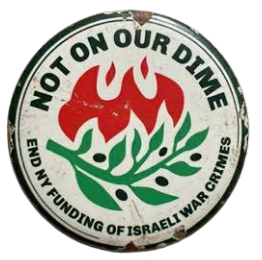
Minnesota’s “Boycott is Free Speech” campaign, founded in early 2025 in response to the ongoing genocide, today comprises over 35 organizations across the state. Campaigns are not gaining momentum just because the timing is right. Like other successful social movements, they are framing their grievances in a way that resonates with the public, elected officials, and potential recruits to repeal campaigns. Even with Palestinian rights now an acceptable topic for progressive politicians, organizers recognize that a powerful draw of repeal bills lies in a distinctly American message: dissent must be protected, boycotts are an American tradition, and free speech is sacred. That’s why Arizona organizers named their campaign “Right to Dissent,” Wisconsin organizers went with “Right to Boycott,” and Minnesota activists recently adopted the name “Free Speech Coalition.” Though they lead with free speech and the constitutional argument, concern with Israeli human rights violations quickly follows. All four campaigns decry a U.S.-backed genocide, call out Israeli apartheid, and broadly argue that there is a moral imperative to use all the tools at our disposal to challenge Israeli human rights violations. Many, like those in Wisconsin, remind their audiences that support for Israeli human rights violations comes at a high cost for Americans: the $260 million that Wisconsin taxpayers spent on weapons for Israel in 2024, they argue, could have been spent on housing, healthcare, or teachers’ salaries.
Illinois’s campaign stands out somewhat by employing a message more explicitly centered on the struggle for Palestinian Rights, with free speech a critical and connected consideration. Working under the umbrella of The Illinois Coalition for Human Rights, their public facing messaging is more directly about Israeli aggressions and the right of every citizen to struggle against them. While the broader effects of anti-boycott laws are present, condemnation of the Israeli government and of U.S. complicity in genocide, occupation, and apartheid makes up the bulk of their messaging.
Still, all four campaigns remind audiences how crucial boycotts are to the American experience. At a recent committee hearing for the repeal bill in Illinois, Chicago attorney Richard Goldwasser stressed that “Boycotts are foundational to who we are as Americans, are an instrumental tool in achieving democratic change, and are as American as baseball and apple pie.” Arizona organizer, Eva Putzova, centered boycotts in the press release for the campaign launch: “The right to boycott is as American as it gets. From the Boston Tea Party to the Civil Rights Movement, everyday people using their economic power to demand justice is how change happens in this country.”
The strength of these campaigns lies in the diversity of their coalitions and their careful reading of the national pulse, allowing them to curate distinct messaging for diverse audiences. Lawyers can speak to the unconstitutionality of the laws, progressive elected officials can challenge U.S. support for Israel, cross-movement organizers can remind audiences that antiboycott bills also target the struggle for environmental and racial justice, and activists can tie anti-boycott laws to the current administration’s authoritarian ways.
Remarks by Daniel Biss, mayor of Evanston and a former state legislator who originally voted for the state’s antiboycott bill, put a fine point on the effectiveness of multi-pronged messaging in a Substack post in support of the repeal bill. Stressing that he’s not a supporter of the BDS movement, he nevertheless argued that support for Palestinian activism is not the point: “The past few years have laid bare the consequences of government using its economic power to bully private entities. All of us have watched as the Trump administration has attacked free speech, often under the guise of combating antisemitism: “… It’s wrong when the Trump administration does it, and I’ve come to believe that laws like Illinois’ ban on investments feed into the framework that makes actions like this possible.” The significance of an elected official going on the record against anti-boycott legislation while running for U.S. Congress—even if softened by a cautious stance on the BDS movement—should not be understated.
Campaigns are, gradually, gaining steam. None more so than Illinois’ coalition, which, after a far-reaching education and outreach campaign, held a subject matter hearing in late April 2026. With 22 co-sponsors in the House and 12 in the Senate, 4,000 constituent letters of support, and over 15,000 witness slips in support of the repeal bill submitted to a subject matter hearing, they have both popular and political momentum. They are, at the time of writing, hoping for a floor vote before the close of the legislative session. Minnesota and Wisconsin have both introduced bills to their respective legislatures, but have yet to receive a hearing.
Their education campaigns have employed similar tactics: lobbying in their state capitals, screening Boycott—Just Vision’s documentary on the topic—with constituents and lawmakers, and employing their broad coalitions to reach outside major cities and the state capital. Both states have faced major challenges. Wisconsin’s repeal effort had to take a backseat when, in 2025, coalition organizers mobilized their resources to oppose a law forcing the adoption of a controversial and often misused definition of antisemitism that too easily conflates criticism of Israel with antisemitism.
Combating the law slowed repeal efforts, but the movement continues to grow, with more cosponsors on board and candidates for the state legislature signing on to the repeal effort as part of their election campaign. Minnesota’s efforts were, likewise, slowed by the ICE occupation of the Twin Cities, an emergency that demanded all the resources available to coalition partners. But education efforts there still pulled in more co-sponsors and supporters, momentum they will bring into the 2027 legislative session.
Arizona’s campaign, more recently formed, is kick-starting its education campaign. With a growing coalition, their education efforts spotlight the erosion of First Amendment protections in Arizona and across the country. Their tactics include public accountability efforts targeting elected officials and candidates who support laws that punish political expression; legal challenges against the anti-boycott law; the likely introduction of a repeal bill; and, should those efforts fail, a ballot initiative to reaffirm free speech rights, including the right to engage in political boycotts.
At the time of writing, no repeal bills have passed. But the ingredients are there not only for an eventual victory, but also for a domino effect across these and other states. With strong and growing coalitions, massive shifts in political sentiment regarding Israeli human rights abuses, fissures in both parties with respect to the U.S.-Israel special relationship, and repression of dissent being normalized at the highest levels, it may only be a matter of time before the first repeal bill breaks the ice. In the meantime, the very existence of concerted campaigns across the country may signal a marked shift, and policy-makers, voters, and organizers alike should take note.
Daniel Nerenberg is Director of Communications for JustVision, the award-winning documentary film producer
Live from New York: It’s Complex Algorithms and Simple Equations
By Ian Williams
This summer’s New York election results had something for everyone. On the one hand, Fox-watcher conservatives branded the Democratic Socialists of America (DSA) as a communist conspiracy, and/or Islamic and antisemitic repudiation of Zionism. On the other, a thin splinter group of Leninist-inclined DSA cadres basked in precisely what their conservative opponents were alleging, and sought to claim ownership of the insurgency. Perversely, the two outliers reinforced each other’s errors, even as they both missed the mark.
I moved to New York from Britain, where, as a trade unionist, Labour Party member, and a speech-writer for Labour leader Neil Kinnock, I had fought against Margaret Thatcher, largely jointly culpable with Ronald Reagan, for ending post-war Western security and prosperity. I had also fought a war of attrition against Neo-Trotskyist infiltrators who had effectively suborned Liverpool’s ruling Labour Party. I was advantaged by my experiences as a teenage Maoist, meeting Chinese Premier Chou En Lai, during the Cultural Revolution, which inoculated me against binary Leninist world views.
With this backstory, I cast critical eyes on any facile analyses of these recent American electoral primaries. As a longtime close observer and occasional member of DSA I must admit that there had indeed been an active infiltration by what one might call the Leninist Left. Many of them who had scorned Bernie Sanders’ “reformism” in the past had opportunistically flooded into DSA, when they saw the upsurge in membership following Bernie’s run against Hilary Clinton.
It’s ‘in the genes’ of these sectarian infiltrators that, faced with their inability to get support for their own ideology, they parasitize other people’s work. Inside DSA they built a revolutionary base area on the organization’s “International Committee,” posturing in solidarity with Putin and sundry tyrants, and exercising performative ideological correctness. This was while more grounded DSA members were knocking on doors and collecting election petitions. Most of the infiltrators’ posturing went unobserved except by the rightwing press, who used it to attack DSA-supported candidates, and so it did not detract too much from the grassroots organizing that the pragmatically strategic majority of DSA was executing.
Obviously, DSA is not the Bolshevik organization these cadres hoped for, and the right allege. After all, its founders came from the anti-Vietnam war wing of the American Socialist party, including Michael Harrington, of «Other America» fame, Irving Howe, other Dissentniks, and many who were old enough to have worked with Norman Thomas, Dorothy Day at the Catholic Worker, or young enough to have been in post-war union organizing drives, including in the South. Those members had long track records of trying to be the “Left Wing of the Possible”, in Harrington’s phrase, and helped to found the NY Working Families Party, worked Democratic floor fights for UAWfunded Democratic Agenda and Democratic Alternatives at the 1976 and 1992 conventions in NYC, and for decades had created a national network. They even elected candidates to Congress and local offices here and there, on a much smaller membership base. DSA drew lessons from the Socialist Party’s past and never acted as a third party.
Despite national elections swamped by TV, radio and internet ads, the complexities of state electoral law in part forced New York progressives to regrow grass roots organizations that could get people canvassing, phone banking and collecting signatures just to get ballot status. In these elections, retro is the future, which helped provide the dynamism for Mamdani against the tired Cuomoesque/Clintonesque corporate Dems.
The Middle East is not the touchstone issue for American elections, even in New York, The DSA’s willingness to speak out on the issues, even to debate it, is a welcome break after years of effectively being frozen in the headlights. Years ago, I asked DSA veterans about the organization’s silence on the issue, and they explained that the various factions basically agreed not to “mention the region,” since so many otherwise progressive Jews were uncomfortable criticizing Israel–think Bernie Sanders and Jerry Nadler until recently. I had seen the same issue in the British Labour Party, where Left icons, like Tony Benn, had often been prominent in the group Labour Friends of Israel until the 1982 Israeli invasion of Lebanon and the Sabra and Shatila massacre. Gaza is now doing same for American progressives. Until recently, this tactical evasion dampened any infighting. Elections had been won on housing and the cost of living, and any criticism of Israel risked being tarred with accusations of anti-Semitism to frighten off aspirant politicians.
That is not to discount the importance of the Israel Lobby’s power in politics. It is no longer just an American phenomenon, but has spread across the whole Anglosphere (and of course, for special reasons, Germany). With minimal backing from their electorates or party members, leaders like Keir Starmer in Britain mounted an unprecedented purge against Netanyahu-skeptic members (which in Starmer’s case, were mostly the left he was ruthlessly supplanting in the party).
The charge of anti-Semitism is wielded exclusively against the Left, which has a large Jewish cohort on both sides of the Atlantic. Conservative and other rightist antisemitism customary from time immemorial was often overlooked and erased by the Murdoch empires.
The three years since the onslaught on Gaza have seen a dramatic decrease in politicians’ hypersensitivity to alleged Jewish concerns about anti-Semitism. Popular support for Middle East justice in the electorate and among Democratic Party and Labour supporters and members has outpaced anything the DSA could have mustered. UK Labour and US Democrat voters could see what was happening in Gaza. The reluctance of Starmer (UK), Cuomo and Goldman (NYC), and others to criticize actions in Gaza has now demonstrably lost them elections.
One of the secrets of Mamdani’s success had been that his campaign for the general electorate only tangentially touched on foreign policy, and when it did, it was often in response to others raising the issue. The “Little Boy blowing the whistle” moment on the Emperor’s new clothes was Mamdani’s neat bridging about the trip to Israel other candidates assumed was mandatory for a New York politician (along with Ireland and Italy for decades). Mamdani’s gotcha riposte –effectively “Why should I?”– upended all the other candidates.
The Middle East remained a hot-button issue in the NY Congressional Seat Democratic Primary between Goldman and Lander, but even there, assumed loyalties to Israel evaporated in the heat of Gaza bombing, bolstered by a resurgent sense of rebellion against the “entitled” heir to the Levi Strauss millions. The reflexive “anti-Semitic” slur thrown against Brad Lander splashed back, perhaps epitomized when the New York Times headline “Jewish Candidate Defeated” about Goldman, without mentioning that Lander, a clearly Jewish and progressive candidate, had won.
NYC voters know and recognize the cognitive dissonance. Being seasoned urbanites, New York voters scorned the hysterical Islamophobia that greeted Mamdani’s first 100 days. They remember that there had indeed been heavy snow and floods even before he took office and the garbage and rats have been a perennial problem. The more he is attacked, the stronger he gets.
Now, for obvious reasons, even passivity and silence on Israeli actions is unpopular, while active support for Netanyahu revolts voters across the electoral spectrum including Jewish voters. In New York, AIPAC candidates had taken for granted electoral support from the many Jews in the region, but they clearly discounted the community’s high ethical standards and its consequent growing preference for Mamdani over Netanyahu.
AIPAC’s historic track record of previous electoral victories understandably imbues “the Lobby” with an aura of omnipotence. However, those depended on sheer cash volume. Neither they nor their supported candidates usually allowed substantive discussion of the Middle East to intrude on their campaigns and perceptibly squirm when explaining their voting record and the source of their funds. Their situation has not improved since Gaza, as reflected in recent election results. Why would people vote against personable and plausible candidates and in favor of tired uninspiring incumbents backed by big money provided in favor of a pariah state by people who hide their funding and motivations?
This reached its epitome in the recent Michigan campaign. $60 million dollars in AIPAC funding failed to seat a candidate who “dreamt of Israel,” against a candidate who repeatedly and loudly wanted justice for his constituents and, when challenged, also for Palestinians.
Although right wing conspiracy theorist and triumphalist leftists both have a vested interest in bemoaning or crowing the overthrow AIPAC, it of course not that simple, as the defeated Jamal Bowman in New York can testify. Sympathizers told me, even before the election, that they had warned him that his campaign neglected the new constituents that redistricting had given him.
There is a historically attested danger to concentrating on foreign affairs. I interviewed both Senator J William Fulbright and Senator Charles Percy for a book project on AIPAC. Both acknowledged the role of the Lobby in their defeat, and both mentioned that the Middle East was not raised as issue in their campaign. But, both adduced that AIPAC’s big telling point was that their active role in the Senate Foreign Relations Committee, implied neglect of in the appropriations committee and rolling the pork barrels home. In the past the Lobby could also rely on an extensive grassroots community network among voters, without making the mistake of conflating Jews with Israel. That has been subsumed as Israel has alienated Jewish voters and AIPAC has become a surrogate for dubious and unpopular corporate interests and billionaires, often with more than a whiff of genuine anti-Semitism about them.
There is a paradigm here, if I may use the word despite its Clintonian connotations. While machine democrats have shifted to DNC Clintonian style funding, DSA and Working Families Party have provided a network of political activists who are mostly attuned to local issues (the DNC International Committee notwithstanding). They have brought forward personable and politically savvy candidates, like Abdul Sayed and Mamdani, and in general they have paid attention to ethnic politics without succumbing to identity politics. It’s a complex algorithm rather than a simple equation, but appears to work in a context of popular revulsion against unprincipled opponents paid for by oligarchs and bigots.
Ian Williams is an author, writer and broadcaster. He has reported from over 60 countries and has been President of the Foreign Press Association of the U.S. since 2019.
Writer from Gaza Receives 2026 AMEU Mahoney Award
Ahmed Abu Artema: “the people of Gaza are the true heroes.”
Ahmed Abu Artema is writer and journalist from Gaza. He recently became the fifth person to be honored with AMEU’s John
F. and Sharon Mahoney Award for Service. For more detail, go to: https://ameu.org/the-mahoney-award/.
On July 29th, the Executive Director of Americans for Middle East Understanding (AMEU) called to inform me that I had been selected to receive the 2026 John and Sharon Mahoney Award for Service. It was a special moment that filled me with joy– an uncommon sentiment for Palestinians of the Gaza Strip these past three years.
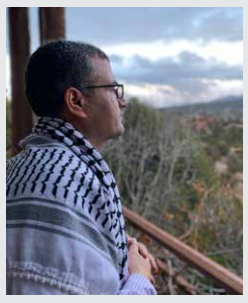
In the Spring of 2018, I was one of thousands of Palestinian activists who locked arms to attempt a new path in the struggle: a mass, nonviolent mobilization known as the Great March of Return, which took place along the apartheid fence that separates the Gaza Strip from occupied Palestine. The march was unarmed; our only weapons were peaceful assembly, cultural and artistic celebrations, and a demand to end more than seventy years of the forced displacement of the Palestinian people.
To our non-violent movement, Israel’s colonial regime responded with live fire– killing more than 220 demonstrators, wounding thousands, and causing amputations and permanent disabilities for hundreds more. The Zionist message was clear: not only did they reject our non-violence, but they refused the Palestinian intention to exist. With the Israel’s violent suppression of the Great March of Return, another opportunity for hope was extinguished; Gaza was forced back into the corner of blockade, and slow death.
In October 2023, the situation exploded when Hamas carried out an armed attack on the settlements near the Gaza Strip. In the aftermath of that attack, Israel launched an unprecedented campaign of destruction against Gaza: they demolished homes with residents still inside, destroyed entire neighborhoods, and leveled cities to the ground, including Rafah, the city where I was born. Nearly all of Gaza’s population was displaced and under constant fire. More than 70,000 people were killed, entire families were erased from the civil registry, and hundreds of thousands were wounded. Hospitals, schools, and infrastructure were devastated, and more than 85 percent of Gaza’s population was made homeless.
On the 17th day of the genocide, on the morning of October 24th, 2023, I was having tea with my children in the living room of my father’s house when Israel struck our home with a U.S.-made F-16 missile. Six of my relatives were killed in the attack, including my 12-year-old son, Abdullah. The seventh victim was our neighbor. The rest of us who were in the house, including my two children and I, were injured. The house was destroyed.
October 2026 will mark the third year of this genocide. There is not a single family in Gaza that has escaped its devastation and there are no indications that the Israeli killing machine will be brought to heel, or that Israeli war criminals will face justice. Israel’s belief that unconditional international support– especially America’s weapons, money, and political cover– is its entitlement, not its privilege. It literally believes it will not be held to account.
My people in the Gaza Strip have lost everything. They have been deprived of safety, peace, and joy, reduced to living in tattered tents, without electricity, adequate healthcare, or basic infrastructure. Their hearts are torn between grief over the loss of their loved ones and the fear of further Israeli aggression. They watch with despair as their children grow old, their futures lost in the collapse of the education system and absent so many of the things that give life dignity.
Gaza today is not only an icon of suffering; it is a witness to the lies and hypocrisy of the global system. Gaza, where tears and blood have never dried, and where joy and safety have become distant memories, continues to confront a machinery of annihilation supported by the global colonial system. Gaza is fighting an unequal battle: the battle of a besieged and defenseless people struggling for survival against a genocidal force backed by overwhelming military power and unconditional international support.
I appreciate AMEU’s honoring me with the 2026 John and Sharon Mahoney Award for Service, and am grateful for the confidence it represents. But there can be no doubt: the people of Gaza are the true heroes. They deserve the honor and support of all who believe in justice and human dignity.